Comment

Marshall Allen’s 101: An Audio Odyssey — Cosmic Jazz Still Refuses to Stand Still

Released by Ropeadope on 24 July 2026, the album finds the veteran alto saxophonist and leader of the Sun Ra Arkestra surrounded by a remarkably eclectic cast, including Jamaaladeen Tacuma, Nels Cline, Immanuel Wilkins, Braxton Bateman and King Noli. Allen contributes alto saxophone, electronic wind instrument (EWI) and kora, whileTacuma serves as a central musical force and producer.

And if that lineup sounds like the ingredients for a beautifully unpredictable session, that's because it is.

A century of music, but no looking backwards

Allen was born in Louisville, Kentucky, on 25 May 1924, and became a member of Sun Ra's Arkestra in the late 1950s. He has led the ensemble since 1995, following the deaths of Sun Ra and then John Gilmore. The Sun Ra Arkestra's own biography lists Allen as a multi-instrumentalist who works across alto saxophone, flute, clarinet, oboe, kora and electronic wind instruments.

That history is impossible to ignore on 101, but the album doesn't behave like a museum piece. Instead, it feels like Allen is taking everything he's accumulated over thosedecades and throwing it into a new laboratory.

The record's eleven tracks move between free improvisation, funk, electronic textures, avant-garde jazz and something considerably harder to pin down. The official tracklist runs from the opening “Bass Thrust” and “Slingshot Effect” through “The Vernacular of the Cosmic,” “Well of Being,” “The Deepest Love,” “Extraterrestrial Groove,” “Funky Robot,” “Cosmic String Slinger,” “Meteor Gathering” and the closing“Ancestral Astral Traveler.”

It's an album that repeatedly changes shape underneath you.
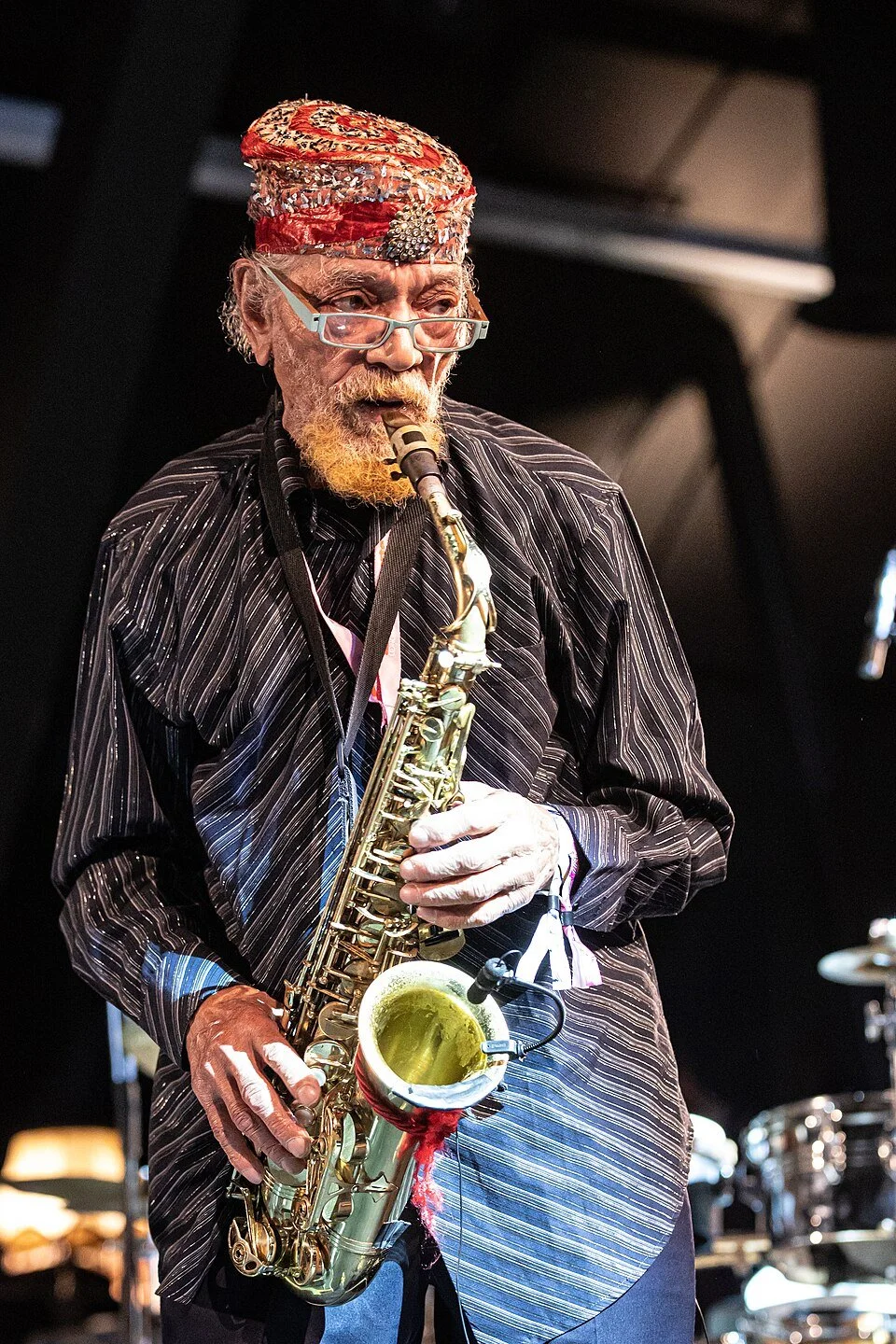
Image credit: Marshall Allen at the Moers Festival, 7 June 2019. Photo by Harald Krichel. Licensed under Creative Commons Attribution-ShareAlike 3.0 Unported (CC BY-SA 3.0). Via Wikimedia Commons.

Big Ears, big ideas

One of the most intriguing parts of the story is how the project came together.

According to Ropeadope, a last-minute cancellation at the Big Ears Festival created an unexpected opportunity for Tacuma and a group of musicians to get into the studio. Nels Cline, Immanuel Wilkins, Braxton Bateman and King Noli were among those involved, with the resulting recordings subsequently developed further with Allen and additional musicians.

A review in PostGenre similarly reports that much of the material originated around the 2025 Big Ears Festival in Knoxville, with further production work taking place afterwards.

That spontaneous beginning makes sense when you hear the music. 101 doesn't sound like a project assembled around a rigid master plan. It sounds like musicians being given enough room to collide, react, disappear and suddenly reappear somewhere completely unexpected.

“Bass Thrust”, for example, places Allen alongside Tacuma and Wilkins, while Cline and Malcolm Charles contribute to the surrounding electronic and rhythmic landscape. Wilkins also switches instruments elsewhere on the album, adding another layer to an already unusually fluid set of combinations.

Then there's “The Deepest Love,” which brings vocalist Tara Middleton into the picture. The track's more recognisable song shape provides a fascinating contrast with Allen's increasingly otherworldly saxophone work.

The Allen effect

Perhaps the most remarkable thing about 101: An Audio Odyssey is that Allen's age is never the musical point.

He turned 100 in 2024 and 102 in May 2026, but the record isn't constructed aroundnostalgia or reverence. His playing remains part of an active musical conversation, rather than an archival footnote. His EWI work can sound startlingly abrasive; his alto can slice through dense arrangements; and on the closing “Ancestral Astral Traveler”, he plays kora while Middleton contributes vocals.

That final appearance on kora is particularly fitting. The National Endowment for the Arts notes that Allen constructed his own kora and has long explored connections betweenavant-garde jazz and traditional African music.

Image credit: Marshall Allen at the Moers Festival, 7 June 2019. Photo by Harald Krichel. Licensed under Creative Commons Attribution-ShareAlike 3.0 Unported (CC BY-SA 3.0). Via Wikimedia Commons.

It's another reminder that Allen's musical universe has never really respected genreboundaries.

And perhaps that's the real secret of 101. Rather than attempting to recreate the sound of Sun Ra's Arkestra, or present Allen as a relic of a particularly adventurous period in jazz history, the album keeps asking what happens next.

Tacuma's electric bass supplies muscular propulsion. Cline brings guitar textures that can be simultaneously melodic and abrasive. Wilkins moves between roles with remarkable flexibility. Around them, Allen seems entirely at home amid electronics, funk grooves, open-ended improvisation and cosmic abstraction.

The result is a record that feels less like a retrospective than another chapter.

101: An Audio Odyssey is out now via Ropeadope, and its eleven-track journey suggests that, for Marshall Allen, the spaceways remain very much open.

Comment

Comment

Andy Sheppard’s Salt Catchers: A Quietly Powerful New Chapter in the ECM Story

There is something wonderfully unhurried about Andy Sheppard’s latest project. Rather than chasing volume, virtuosity or obvious drama, Salt Catchers settles into the spaces between notes — an intimate new trio recording that brings the British saxophonist together with Italian pianist Rita Marcotulli and French double bassist Michel Benita.

Released by ECM on 11 September 2026, the album was recorded in March 2025 at the Auditorio Stelio Molo RSI in Lugano, Switzerland, with Manfred Eicher producing. It is Sheppard’s latest ECM project and introduces a trio whose chemistry is built around melody, atmosphere and close musical conversation.

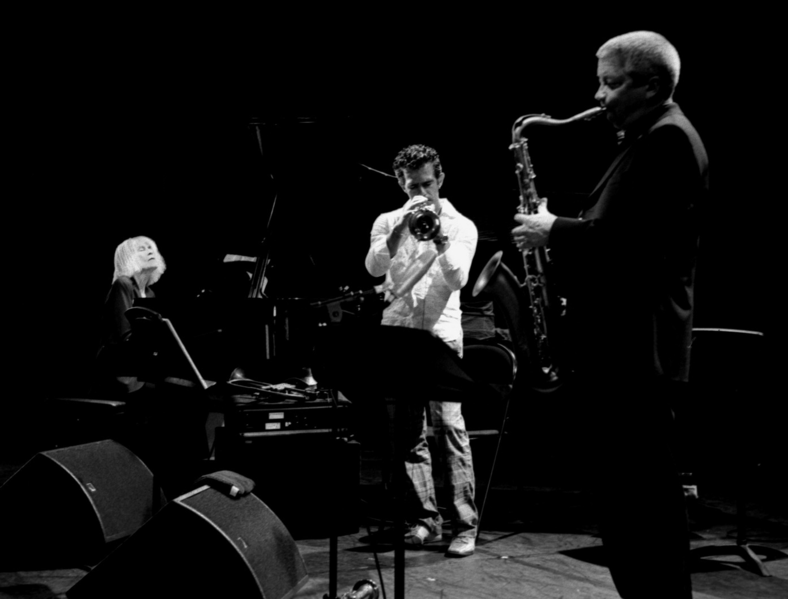
Image credit: Adam Cuerden, Paolo Fresu, Carla Bley e Andy Sheppard, Wikimedia Commons. CC BY-SA 3.0.

Three musicians, one remarkably spacious sound

The most striking thing about Salt Catchers is its instrumentation. There are no drums here. Instead, Sheppard’s tenor and soprano saxophones, Marcotulli’s piano and Benita’s double bass create an unusually open sonic landscape, allowing individual phrases to hang in the air before another player answers.

That spaciousness is very much in keeping with Sheppard’s ECM work, but this is notsimply a continuation of one of his earlier groups. Marcotulli and Benita are musicians Sheppard has known for a long time and worked with in live settings, although Salt Catchers marks the first time the three have recorded together as a collective.

The album contains nine tracks, eight written by Sheppard and one — the beautifully understated “Lawns” — by the late American composer and pianist Carla Bley. The remaining programme includes the title track alongside “Elevation”, “Encantos”, “Draw You In Stars”, “This Too – Three Hills”, “Salgado”, “Those That Left” and “Irene”.

A familiar musical connection

Bley’s presence on Salt Catchers carries particular resonance. Sheppard spent decadesworking with Bley and bassist Steve Swallow, recording a series of celebrated trio albums including Trios, Andando el Tiempo and Life Goes On. “Lawns” therefore placesa small but significant thread of that history inside this new trio.

It also makes Salt Catchers feel less like a reset than another chapter in Sheppard’s long-running interest in lyrical, highly conversational jazz. His ECM catalogue has previously taken him through the exploratory Trio Libero, the Andy Sheppard Quartet and various collaborations with Bley and Swallow. The new recording pares the formatback even further, giving the music plenty of room to breathe.

And Marcotulli is hardly a newcomer to Sheppard's musical world. The pair have collaborated previously, including on recordings such as Koine, On the Edge of a PerfectMoment and Us and Them. Her long experience as a pianist and composer gives the trio another distinctive melodic voice rather than simply a conventional rhythm-section role.

Rita Marcotulli. Image credit: Hreinn Gudlaugsson, Wikimedia Commons, CC BY 4.0.

An album built on restraint

The title track gives the record its centre of gravity, but the overall impression is lessabout one grand statement than a sequence of carefully balanced encounters. ECM describes the music as characterised by melodic beauty, delicate harmony and thoughtful interplay — a description that fits the drumless configuration particularly well.

There is also a sense of continuity in the recording location. Sheppard has repeatedly returned to the Auditorio Stelio Molo RSI in Lugano for important ECM sessions, including Trio Libero and other projects. The hall has consequently become part of the sonic geography surrounding some of his most intimate recordings.

Salt Catchers arrives, then, as a record concerned with detail rather than spectacle. Sheppard’s saxophone remains the unmistakable focal voice, but Marcotulli and Benita are never reduced to accompaniment. The three musicians operate more like three sides of the same conversation — sometimes answering, sometimes shadowing, sometimes simply allowing silence to do part of the work.

For listeners who enjoy their jazz spacious, melodic and finely textured, Salt Catchersoffers another intriguing entry in Andy Sheppard’s ECM journey — and a meeting of three musicians whose shared history finally gets the recording it has been waiting for.

Comment

Comment

A Night In Texas Drag Deathcore Into Its Bleakest Territory Yet

There are few bands in modern deathcore who seem quite as comfortable staring directly into the abyss as A Night In Texas. On The Darkest Side Of Humanity, the Australian outfit don't simply turn up the distortion and start swinging the breakdown hammer. They go looking for the uglier corners of the human experience — mortality, suffering, instinct, exploitation and the darker impulses that sit beneath civilisation — and build a suitably monstrous soundtrack around them.

Due for release on September 4, 2026 through Unique Leader Records, the album is the band's fifth full-length and follows 2024's Digital Apocalypse. The record also marks the first A Night In Texas album to feature drummer Chris Whitbread, who joined the lineup during 2026. The current quartet is completed by vocalist Sam Cameron, guitarist Cory Judd and guitarist Thomas (Tommy) Williams, with David Finlay also credited in recent band lineups.

If the title sounds like a warning, the music backs it up.

From the opening moments of “Oblivion's Dominion”, A Night In Texas establish a world where atmosphere matters almost as much as sheer violence. The technical guitar work is fast, intricate and punishing, but it is the contrast between claustrophobic atmosphere and sudden eruptions of brutality that gives the record much of its character. MetalTalk described the album as a return to the ferocity of the band's earlier work, while retaining the technical precision that has become central to their identity.

Then comes “Rot From Within”, and the gloves are very firmly off.

This is where the band's technical deathcore credentials really come to the foreground. Rapid-fire guitars, hyperactive drumming and Cameron's extreme vocal range collide with the kind of breakdown that sounds engineered specifically to turn a pit into a demolition site. It is intricate without becoming sterile, and brutally physical without reducing everything to a sequence of predictable chugs.

That balance has been an important part of A Night In Texas since the band's early records. Formed in Cairns in 2009 before relocating to Brisbane, the group built its reputation through a particularly technical strain of deathcore, with The God Delusionand Global Slaughter establishing a taste for blistering tempos, intricate riffing, savage vocals and bleak subject matter. Their 2021 double album The Divine Dichotomyexpanded that approach before Digital Apocalypse pushed into a more futuristic, cybernetic world.

The Darkest Side Of Humanity feels like a different kind of darkness.

Take “Metastatic Misery”, the album's first single. Beneath the relentless blast beats and suffocating guitars is a genuinely grim concept: the song examines the commercialisation of disease and the way human suffering can become entangled with profit. Rather than using darkness merely as an aesthetic, A Night In Texas are aiming their brutality at something recognisably human.

That idea appears to permeate the album. The ten-track sequence moves through themes of death, suffering, mortality, deception and primal human behaviour, giving the record a conceptual weight that goes beyond simply being another exercise in extreme-metal excess. The track list runs from “Oblivion's Dominion” through “Rot From Within”, “Fed To Death”, “Metastatic Misery”, “Evolved From Hate”, “When The Sun Burns Out” and “A Primal Conditioning”, before closing with “The Chronicles Of Nihilism”, “The Infinite Maw” and the title track.

And there are some particularly interesting names lurking in the credits.

Former A Night In Texas vocalist Rheese Peters returns for “The Chronicles Of Nihilism”, while Ryan Vail of Synestia/Larcenia Roe appears on “The Infinite Maw”. Those guest appearances add another layer to a record already designed to sound cinematic and enormous.

Behind the desk, guitarist Cory Judd takes production duties, while Christian Donaldson handles the mix and mastering. Donaldson's work with extreme-metal heavyweights including Cryptopsy, Ingested and Despised Icon makes him a particularly appropriate choice for a record that needs to retain both microscopic technical detail and devastating low-end impact.

Early reviews suggest the gamble has paid off. MetalTalk praised the record's technical musicianship, symphonic touches and relentless aggression, highlighting tracks including “Rot From Within”, “Fed To Death”, “When The Sun Burns Out” and the title track. Another review noted the way the band combines precision with an oppressive, contemporary deathcore sound rather than relying purely on breakdowns.

The result is an album that understands something fundamental about extreme metal: heaviness isn't always about playing faster or tuning lower. Sometimes it is about creating an atmosphere so bleak that the listener feels trapped inside it.

A Night In Texas have spent more than a decade sharpening that weapon. With The Darkest Side Of Humanity, they appear to have found an especially vicious target — humanity itself.

And judging by the evidence so far, they aren't interested in looking away.

Comment

Comment

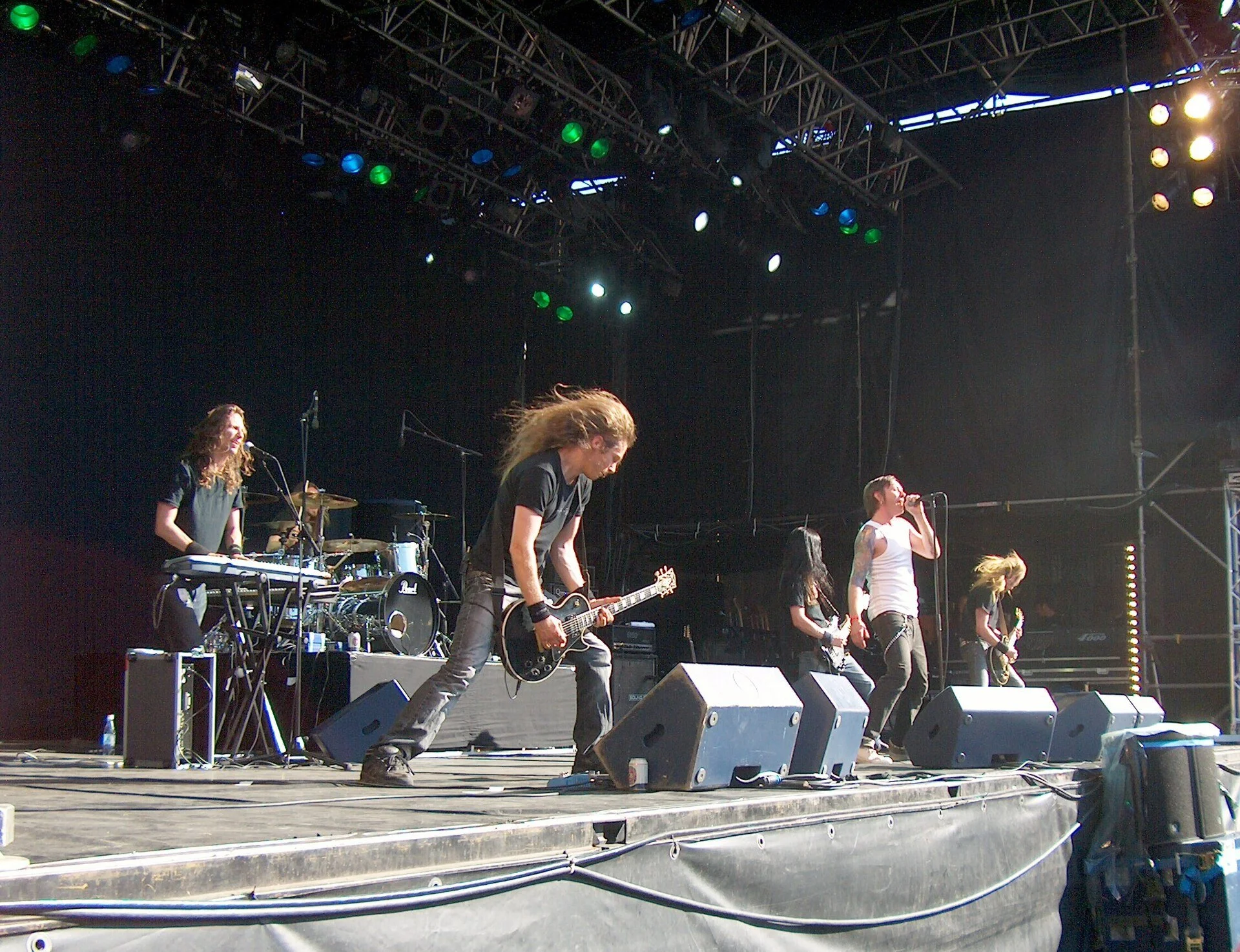
On "Achilles" Audrey Horne Sharpen Their Sound

Audrey Horne have never sounded particularly interested in standing still. There is a restless energy running through Achilles, their eighth studio album, as though the Norwegian rockers have walked back into the studio with something to prove — not to anyone else, but perhaps to themselves.

Four years after Devil’s Bell, the Bergen five-piece return with a record that feels seasoned without sounding tired. The riffs are big, the twin-guitar work remains a major attraction, and the choruses still have the kind of lift that makes you instinctively reach for the volume control. Yet there is also more room here for atmosphere, groove and unexpected turns.

Audrey Horne performing live at Sauna Open Air 2010, Tampere, Finland. Photo: Fileri. Licensed under CC BY-SA 3.0.

Due for release on September 4, 2026 through Napalm Records, Achilles arrives with 11 tracks that draw freely from the classic hard-rock tradition while giving Audrey Horne plenty of space to put their own stamp on it.

The title track wastes little time establishing the mood. “Achilles” crashes in with weight and purpose before opening out into more expansive territory, with Toschie’s vocals riding over the band's muscular rhythm section. Its lyrics take inspiration from an increasingly polarised world, giving the song a contemporary edge beneath its classic-rock foundations.

Then comes “God Damn Beautiful”, which pulls the listener somewhere altogether different. With its swaggering groove and Thin Lizzy-inspired guitar work, the track has an easy confidence about it — made even more distinctive by bassist Espen Lien taking over lead-vocal duties.

“Insanity” pushes further into the band's more dramatic side. The first song written for the album, it combines twin guitars, a huge chorus and a striking middle section, while its narrative is imagined as a kind of prequel to Iron Maiden's “Hallowed Be Thy Name”. It's a suitably grand piece of storytelling for a band whose music has always had an eye for the theatrical.

Elsewhere, Achilles knows when to slow down. “Pretty Little Lies” brings a darker, more melancholic character to the record, while “New Star Falling” provides a melodic finale. Those changes of pace give the album breathing room and prevent its heavier moments from blurring together.

The appeal of Audrey Horne has always been rooted in their ability to make familiar ingredients feel freshly assembled. Their affection for the great hard-rock records of the 1970s and 1980s is hardly hidden, but Achilles doesn't come across as an exercise in nostalgia. The band's influences are there in the riffs, harmonies and arrangements, yet the performances have enough personality to make the material unmistakably theirs.

Audrey Horne live at Quart Festival 05, Kristiansand, July 2005. Photo: Mike Rophone. Released into the public domain by the author.

Formed in Bergen in 2002, Audrey Horne have now spent more than two decades refining that identity. From their early records through Youngblood, Pure Heavy, Blackout and Devil's Bell, they've built a reputation for combining muscular rock songwriting with melody and an obvious love of playing live.

Achilles feels like another confident step in that ongoing journey. There are huge riffs here, memorable choruses, moments of genuine atmosphere and just enough left turns to keep the listener guessing. Audrey Horne aren't trying to disguise where they came from — they're simply showing that there is still plenty they can do with it.

And after eight albums, that might be the most convincing argument for Achilles: it sounds like a band that still has somewhere to go.

Comment

Comment

Orchestra Baobab Bring Dakar’s Golden Groove to Life at Snape Maltings

Senegal’s legendary Afro-Cuban ensemble turned Snape Maltings into a dancefloor on a high-energy night of irresistible rhythms, timeless songs and seriously infectious grooves.

There are concerts where you sit back and listen. And then there are concerts where the music seems to make the decision for you.

When Orchestra Baobab arrived at Snape Maltings on 22 August, the latter was very much the order of the night. The Senegalese institution brought the 2026 Summer at Snape series to an exuberant close, delivering the kind of performance that makes the phrase “world music” feel far too small for what is actually happening on stage.

Credit: Neodop / Wikimedia Commons
Licence: Creative Commons Attribution-ShareAlike 4.0 International (CC BY-SA 4.0).

Founded in Dakar in 1970 as the house band of the Baobab Club, Orchestra Baobab became one of the defining ensembles of Senegal’s post-independence musical culture. Their secret has never been a single genre, but the way they make seemingly distant traditions lock together: Afro-Cuban rhythms, Senegalese styles, Wolof vocals, jazz-inflected guitar and an unmistakable love of the dancefloor.

That mixture was everywhere at Snape.

The evening opened at an easy, spacious pace before the percussion began tightening the screws. Congas, timbales and drums supplied a rolling rhythmic engine, while the horns and guitars floated above it. Contemporary coverage of the concert singled out percussionist Taga Koité, who has been with the group since the 1970s, alongside musical director and saxophonist Thierno Koité.

The result was music that could be sophisticated without ever becoming stiff. One moment the band was threading intricate cross-rhythms through sharply executed stops; the next, it was gliding into a slow, romantic ballad before switching gears again for a dance number. The repertoire moved between languages including Wolof, French, Spanish and Portuguese Creole, reinforcing the cosmopolitan character that has always been central to Baobab's identity.

A sound built for movement

Guitarist René Sowatche proved another standout, his semi-acoustic playing providing melodic flourishes that cut elegantly through the rhythm section. Meanwhile, the audience increasingly became part of the performance itself.

By the middle of the first set, dancing had spilled into the aisles, with people moving towards the front of the hall. It was a fitting response to a band whose music has always treated rhythm not as decoration, but as the main event.

The second half pushed the temperature still higher, opening with a salsa-inflected number and a particularly striking interplay between the percussion and saxophones. The band seemed to encourage the crowd as much as entertain it, with the musicians visibly responding to the dancers gathered in front of the stage.

It is perhaps the greatest compliment that can be paid to Orchestra Baobab: despite the musical detail beneath the surface, nothing felt academic. The rhythms could be intricate, the arrangements multi-layered and the instrumental interplay remarkably tight, but the groove was never sacrificed.

That balance has been part of Baobab's appeal since their remarkable revival at the beginning of the 2000s. After a long hiatus, the group returned to prominence with Specialist in All Styles in 2002, an album that The Guardian described at the time as a major comeback and praised for bringing together Cuban dance influences, Senegalese musical traditions and pop melodies.

More than two decades later, the band is still evolving.

Credit: Bunks / Wikimedia Commons
Licence: Creative Commons Attribution 3.0 Unported (CC BY 3.0).

The Baobab tree keeps growing

Snape's concert arrived just weeks before the release of Made in Senegal, Orchestra Baobab's first new studio album since 2017's Tribute to Ndiouga Dieng. Recorded entirely in Dakar and due on Strut Records on 23 October 2026, the album brings together veteran musicians and a younger generation of players, with new material sitting alongside reworked pieces from the group's extraordinary catalogue.

Among the album's tracks is “Baobab 50 Ans”, marking the group's half-century legacy, while “Casamance” looks towards the culturally rich region of southern Senegal associated with several members of the Orchestra Baobab story.

There is something especially appropriate about Orchestra Baobab playing at Snape Maltings. This is music with history in its bones, but it is not museum music. It still moves, still surprises and, judging by the reaction in the hall, still gets people out of their seats.

For a band approaching its sixth decade, that is no small achievement.

Orchestra Baobab's great trick is to make longevity sound like freedom rather than nostalgia. The old rhythms remain, the songs retain their character, but the musicians keep finding new space inside them.

At Snape, the result was a glorious reminder that some grooves don't age. They simply grow deeper roots.

Comment