
Audrey Horne have never sounded particularly interested in standing still. There is a restless energy running through Achilles, their eighth studio album, as though the Norwegian rockers have walked back into the studio with something to prove — not to anyone else, but perhaps to themselves.
Four years after Devil’s Bell, the Bergen five-piece return with a record that feels seasoned without sounding tired. The riffs are big, the twin-guitar work remains a major attraction, and the choruses still have the kind of lift that makes you instinctively reach for the volume control. Yet there is also more room here for atmosphere, groove and unexpected turns.

Audrey Horne performing live at Sauna Open Air 2010, Tampere, Finland. Photo: Fileri. Licensed under CC BY-SA 3.0.
Due for release on September 4, 2026 through Napalm Records, Achilles arrives with 11 tracks that draw freely from the classic hard-rock tradition while giving Audrey Horne plenty of space to put their own stamp on it.
The title track wastes little time establishing the mood. “Achilles” crashes in with weight and purpose before opening out into more expansive territory, with Toschie’s vocals riding over the band's muscular rhythm section. Its lyrics take inspiration from an increasingly polarised world, giving the song a contemporary edge beneath its classic-rock foundations.
Then comes “God Damn Beautiful”, which pulls the listener somewhere altogether different. With its swaggering groove and Thin Lizzy-inspired guitar work, the track has an easy confidence about it — made even more distinctive by bassist Espen Lien taking over lead-vocal duties.
“Insanity” pushes further into the band's more dramatic side. The first song written for the album, it combines twin guitars, a huge chorus and a striking middle section, while its narrative is imagined as a kind of prequel to Iron Maiden's “Hallowed Be Thy Name”. It's a suitably grand piece of storytelling for a band whose music has always had an eye for the theatrical.
Elsewhere, Achilles knows when to slow down. “Pretty Little Lies” brings a darker, more melancholic character to the record, while “New Star Falling” provides a melodic finale. Those changes of pace give the album breathing room and prevent its heavier moments from blurring together.
The appeal of Audrey Horne has always been rooted in their ability to make familiar ingredients feel freshly assembled. Their affection for the great hard-rock records of the 1970s and 1980s is hardly hidden, but Achilles doesn't come across as an exercise in nostalgia. The band's influences are there in the riffs, harmonies and arrangements, yet the performances have enough personality to make the material unmistakably theirs.
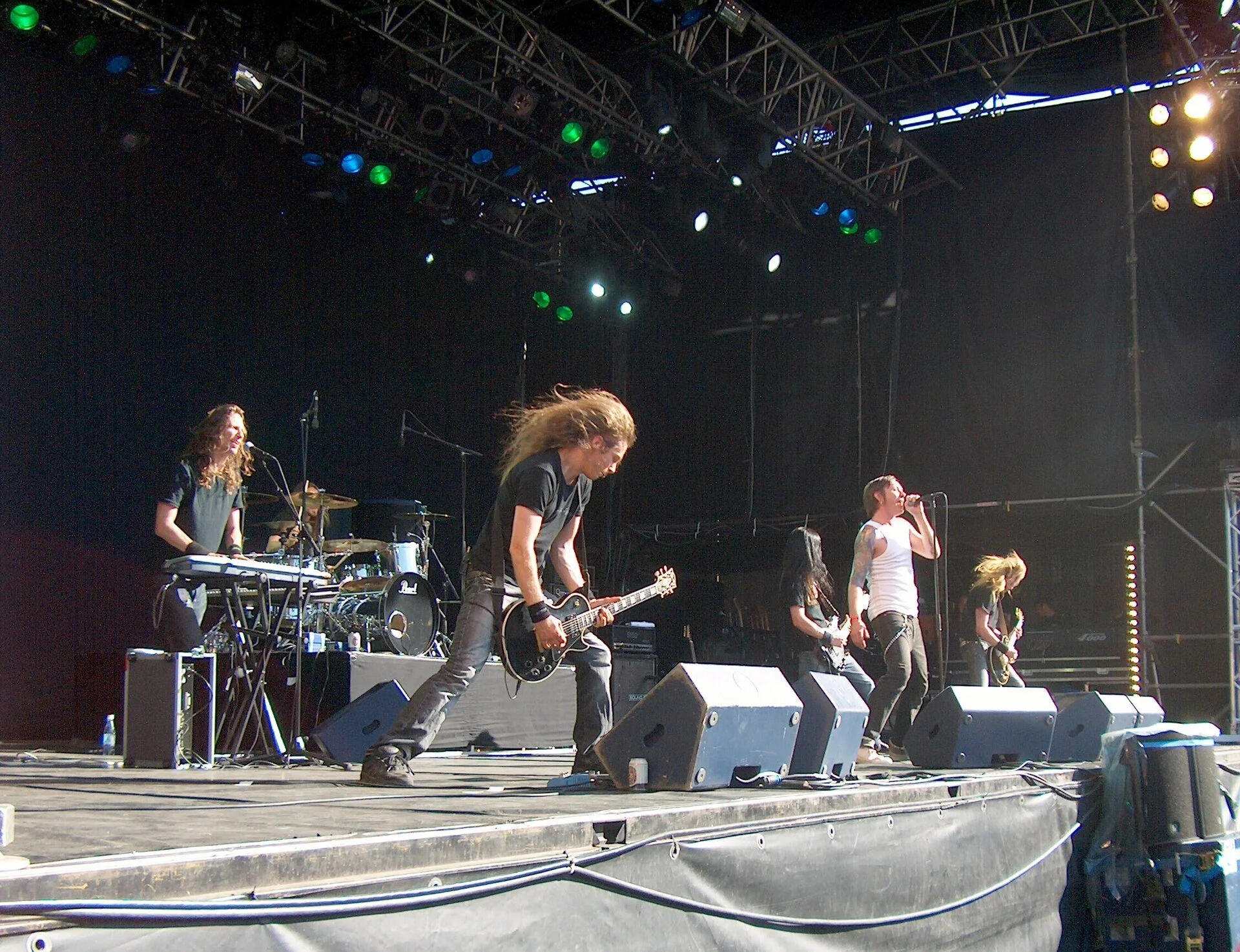
Audrey Horne live at Quart Festival 05, Kristiansand, July 2005. Photo: Mike Rophone. Released into the public domain by the author.
Formed in Bergen in 2002, Audrey Horne have now spent more than two decades refining that identity. From their early records through Youngblood, Pure Heavy, Blackout and Devil's Bell, they've built a reputation for combining muscular rock songwriting with melody and an obvious love of playing live.
Achilles feels like another confident step in that ongoing journey. There are huge riffs here, memorable choruses, moments of genuine atmosphere and just enough left turns to keep the listener guessing. Audrey Horne aren't trying to disguise where they came from — they're simply showing that there is still plenty they can do with it.
And after eight albums, that might be the most convincing argument for Achilles: it sounds like a band that still has somewhere to go.