
Kai Hansen has spent four decades helping define European power metal. On his new solo album, he sounds less interested in preserving that legacy than smashing it open and seeing what happens.
There are musicians who carefully tend their legacy, and then there is Kai Hansen. Afterhelping establish Helloween and later building Gamma Ray into one of Germany's defining metal acts, Hansen could be forgiven for sticking to the formula that made his name.
Instead, Born With A Hammer goes wandering.
Released on 18 September 2026 through earMUSIC, the ten-track album is Hansen'sfirst solo studio album since XXX – Three Decades in Metal, released in 2016 under the Hansen & Friends banner. The official announcement describes the new record as drawing together heavy metal, punk attitude, hard rock, melodic hooks and guitar-driven energy — and that description turns out to be remarkably accurate.
The Hansen DNA is still all over it
The opening track, “Feeding The Beast,” initially takes a surprisingly restrained route before the guitars kick the door in. It is a useful introduction to the album because Hansen's familiar melodic instincts are still there, but the arrangements aren't simply trying to recreate classic Helloween or Gamma Ray.
That distinction matters.
Hansen co-founded Helloween in the 1980s and left the band in 1989, subsequently forming Gamma Ray. Gamma Ray's own history confirms that Heading for Tomorrowarrived in January 1990 and established the band's melodic, bombastic power-metal approach.
More than three decades later, Born With A Hammer feels like Hansen giving himself permission to step sideways.
“Welcome To Life” brings a punkier attitude and even an unexpected reggae/ska-flavoured passage, while “Don't Care” leans into a playful, rebellious energy. “Wait And See” heads somewhere darker, with a heavier, more mechanical feel. Those stylistic shifts are also reflected across contemporary reviews, which variously identify punk, hard rock, industrial textures, pop elements and traditional metal in the album's musical palette.
And then there is the title track.
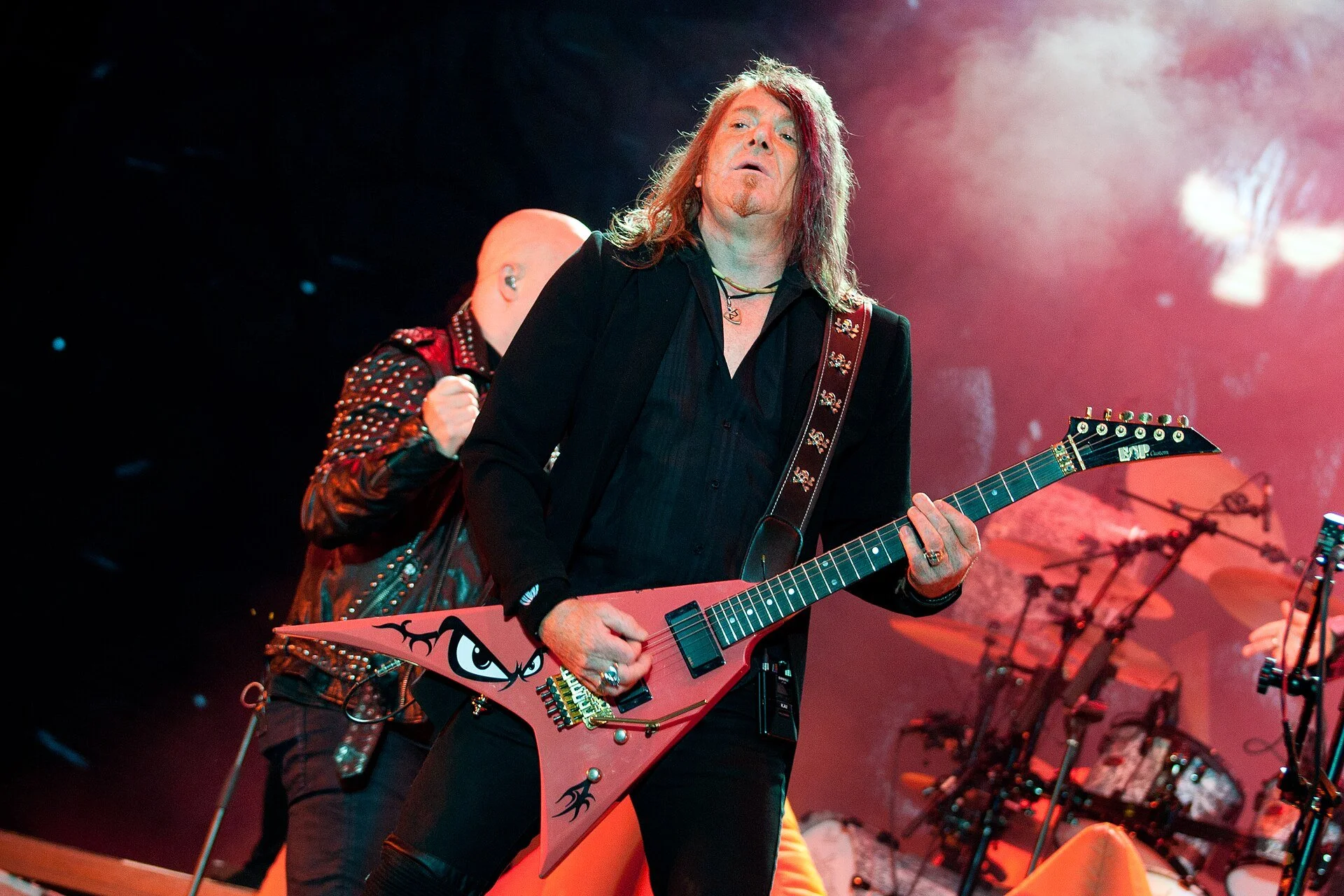
Helloween-Kai Hansen by vSpectrum.jpg, via Wikimedia Commons, licensed CC BY-SA 4.0
Eight minutes of glorious excess
At more than eight minutes, “Born With A Hammer” is the album's great sprawling centrepiece. It begins comparatively gently, develops through several contrasting passages and eventually embraces a distinctly theatrical scale, with multiple reviewers noting the influence of Queen.
It is precisely the sort of track that could have become hopelessly overstuffed in lessconfident hands. Instead, Hansen uses the extended running time to let the song breathe, change direction and indulge in the sort of grand melodic gestures that havealways been part of his musical vocabulary.
Elsewhere, “I.D.G.A.F.” is one of the record's biggest left turns, while “End Of TheRoad” provides something closer to the classic Hansen sound. “Triple Trouble” features Hansen's son Tim Hansen on guitar, and the album's core lineup also includesguitarist/producer Eike Freese, Alexander Dietz of Heaven Shall Burn and Dan Wildingof Carcass on drums.
Not another Keeper — and that's the point
There is an obvious temptation with any new Kai Hansen record to measure it againstthe history of Helloween and Gamma Ray. After all, Hansen was part of the earlyHelloween lineup and contributed to the band's formative records before departing, while Gamma Ray went on to become a major force in German power metal.
Born With A Hammer makes that comparison less useful than it might initially seem.
This isn't an attempt to recreate Keeper of the Seven Keys. Nor is it simply a Gamma Ray album wearing a different jacket. Instead, Hansen throws familiar heavy-metal muscle into a much broader musical playground. The result moves between traditional metal, power metal, hard rock and punk-flavoured material, occasionally adding strangertextures along the way.
That doesn't mean every experiment is destined to land perfectly. Reviews havedisagreed about the album's consistency, with some finding its stylistic variety exhilarating and others feeling that the different ideas occasionally pull against each other.
But perhaps that's what makes the record interesting.
After spending so much of his career helping define what European power metal could sound like, Hansen doesn't seem particularly interested in following his own rulebook.
The hammer is still there. He's just decided to hit a few different things with it.