
There is something wonderfully mischievous about Joshua Cavanagh-Brierley’s The Mild Mannered and the Mortal. The title sounds almost self-effacing, but the music underneath it is anything but.
Released by Manchester’s Efpi Records on 7 August 2026, the album is the fourth release as a leader from the Manchester-based double bassist and composer. It brings together a new sextet built around the rhythm-section chemistry of Cavanagh-Brierley’s Angle Shades trio — pianist Richard Jones and drummer Johnny Hunter — with trumpeter Graham South, tenor saxophonist Kyran Matthews and trombonist Ellie Smith completing the frontline. Olivia Cuttill also appears on trumpet on “Rich and Catherine”.
The result is a record that repeatedly sounds bigger than the personnel on the sleeve. Cavanagh-Brierley has a history of writing for larger ensembles — his 2021 album Joy in Bewilderment expanded as far as a 12-piece group and featured American saxophonist Chris Potter — but here he achieves a similarly expansive effect with considerably fewer musicians.
A dream, a ghost of Mingus, and eight new compositions
The strangest part of the story may be how the album began. Cavanagh-Brierley has explained that the project grew from a vivid dream about discovering a previously unknown Charles Mingus album. Rather than simply waking up and forgetting it, he tried to reconstruct the music he had heard in the dream, eventually producing “Toby Would’ve Hated This”, a piece that gives Smith’s trombone a particularly prominent role.
That Mingus connection is important, but The Mild Mannered and the Mortal isn't simply an exercise in retro jazz cosplay. Cavanagh-Brierley has been clear that he wasn't attempting to make a Mingus album — instead, the aim was to capture something of the older bassist-composer's exuberance, unpredictability and sheer delight in musical interaction. The distinction matters.
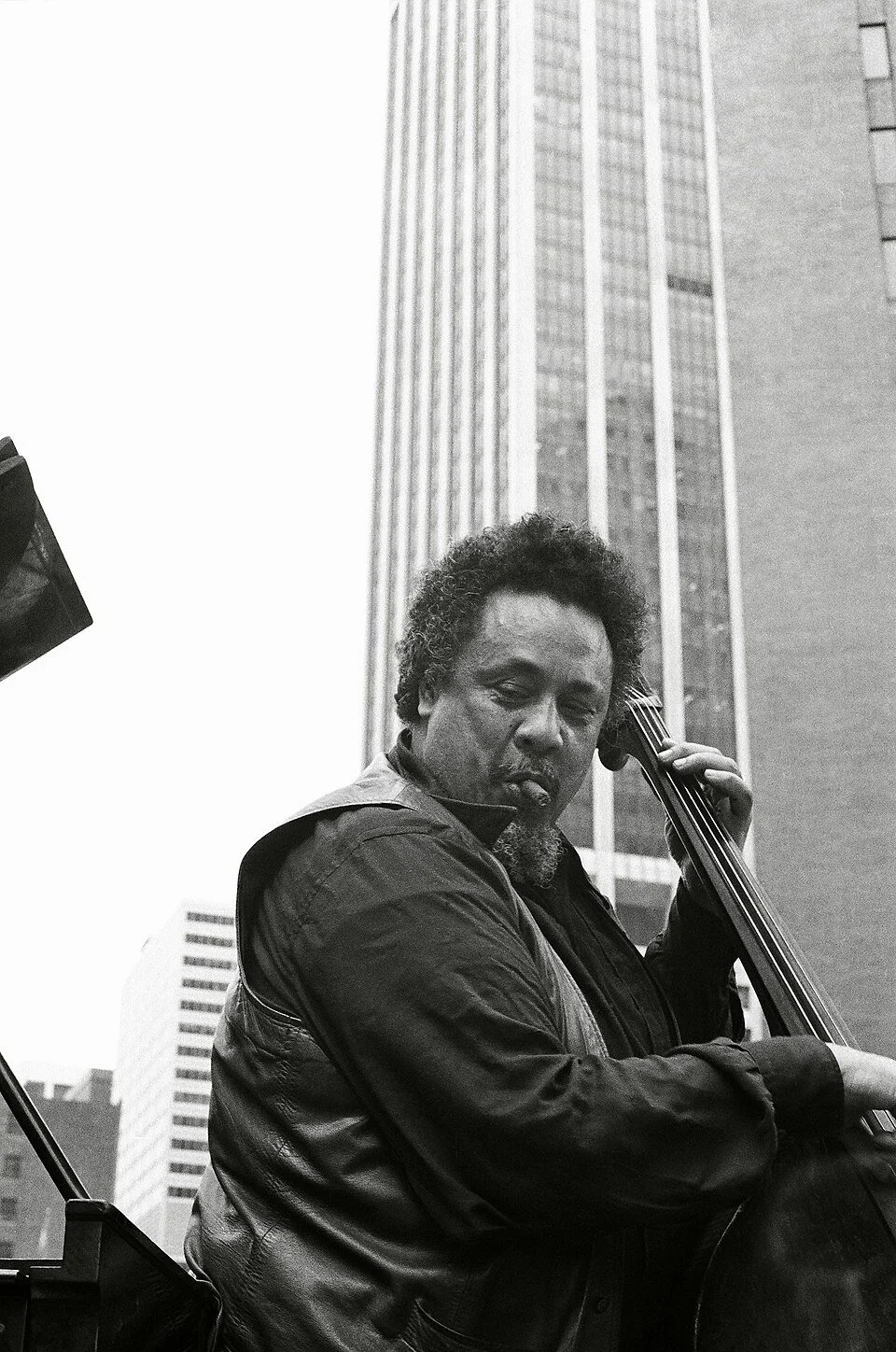
Image credit: Charles Mingus, photographed by Tom Marcello at the Bi-Centennial celebration in Lower Manhattan, 4 July 1976. Wikimedia Commons. Licensed CC BY-SA 2.0.
When a sextet sounds like a small orchestra
The album's opening track, “Elvin's Lullaby”, establishes the approach immediately: long horn melodies, richly layered ensemble writing and Jones's piano threading through the arrangement before South takes an expansive solo. “25 O'clock” pushes harder, with Hunter driving the group into something approaching miniature big-band territory.
Then comes “Can't Get A Luckin'”, a 12½-minute journey through shifting styles and tempos that finally gives Cavanagh-Brierley a chance to step out from behind the composer's desk and put his double-bass playing front and centre. “Rich and Catherine”, meanwhile, changes the temperature, allowing Cuttill's trumpet to bring a warmer, more lyrical quality to the record.
It's this ability to change shape without losing the identity of the band that makes the record particularly compelling. One moment the horns suggest a compact big band; the next, the music is opening into something looser and more abstract.
“Lift Off” lives up to its name, turning the sextet into a punchy, high-energy unit, while the title track — listed as “The Mild Mannered are the Mortal” — moves through multiple dynamic and stylistic shifts. Jones, previously operating largely as an ensemble player, gets room to really stretch out, producing one of the album's standout piano performances.
The North's new jazz energy
Perhaps the most exciting thing about the record is that it feels less like a showcase for one composer than a conversation between musicians who know exactly how far they can push one another.
Cavanagh-Brierley has described the familiarity between the core players as a major part of the writing process, and that familiarity comes through in the looseness beneath the elaborate arrangements. The recording was made in Manchester in March 2024 with the musicians playing together in the same room, rather than being separated into isolation booths — a choice that helps explain the unusually immediate ensemble sound.
Kyran Matthews is particularly prominent, delivering a muscular tenor presence throughout, while Hunter's drumming provides a flexible engine capable of moving from supportive propulsion to full-on rhythmic attack. Smith's trombone gives the three-horn front line an earthy weight, while Jones and Cavanagh-Brierley keep the harmonic and rhythmic machinery constantly shifting beneath it.
Potter's appearance on Joy in Bewilderment also provides a useful reminder of how wide Cavanagh-Brierley's musical world already is. His official biography lists work with Potter alongside artists including Matthew Halsall, Nishla Smith, Caoilfhionn Rose Birley and the Beats & Pieces Big Band, as well as orchestral work and theatre productions.
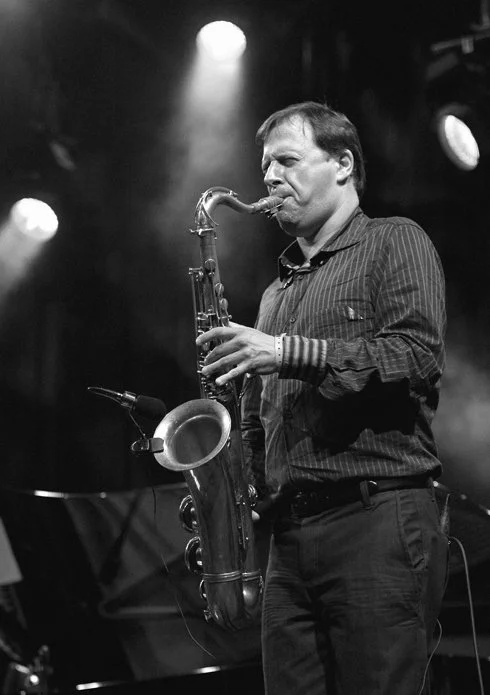
Image credit: Chris Potter at the North Sea Jazz Festival, photographed by Geert Vandepoele. Wikimedia Commons. Licensed CC BY-SA 2.0.
Mild manners, mortal consequences
For all its sophistication, The Mild Mannered and the Mortal never seems overly concerned with proving how clever it is. That's arguably its greatest strength.
There are complex harmonies, abrupt turns, extended improvisations and carefully orchestrated passages everywhere, but the arrangements leave genuine space for the players. Even the album's more intricate moments retain a sense of movement and personality rather than becoming exercises in compositional gymnastics. Independent reviews have similarly singled out the balance between detailed writing and freedom for the soloists.
And then there is “Mr. Relaxed”, the closing track whose title proves to be a wonderfully unreliable description. The piece is lively, with energetic ensemble interplay followed by solos from South, Jones and Matthews. It's a fitting finale for an album whose supposed mildness repeatedly gives way to something much more animated.
At well over an hour, this isn't background music. It's an album that demands a little time — but rewards it with the sense that something is constantly happening just around the corner.
Joshua Cavanagh-Brierley's The Mild Mannered and the Mortal may borrow a mischievous spark from Mingus, but it ultimately belongs to its own moment: a Manchester-made, forward-looking jazz record full of restless arrangements, heavyweight ensemble playing and musicians clearly enjoying the freedom to surprise one another.
And for a record called The Mild Mannered and the Mortal, that's a pretty lively way to be.